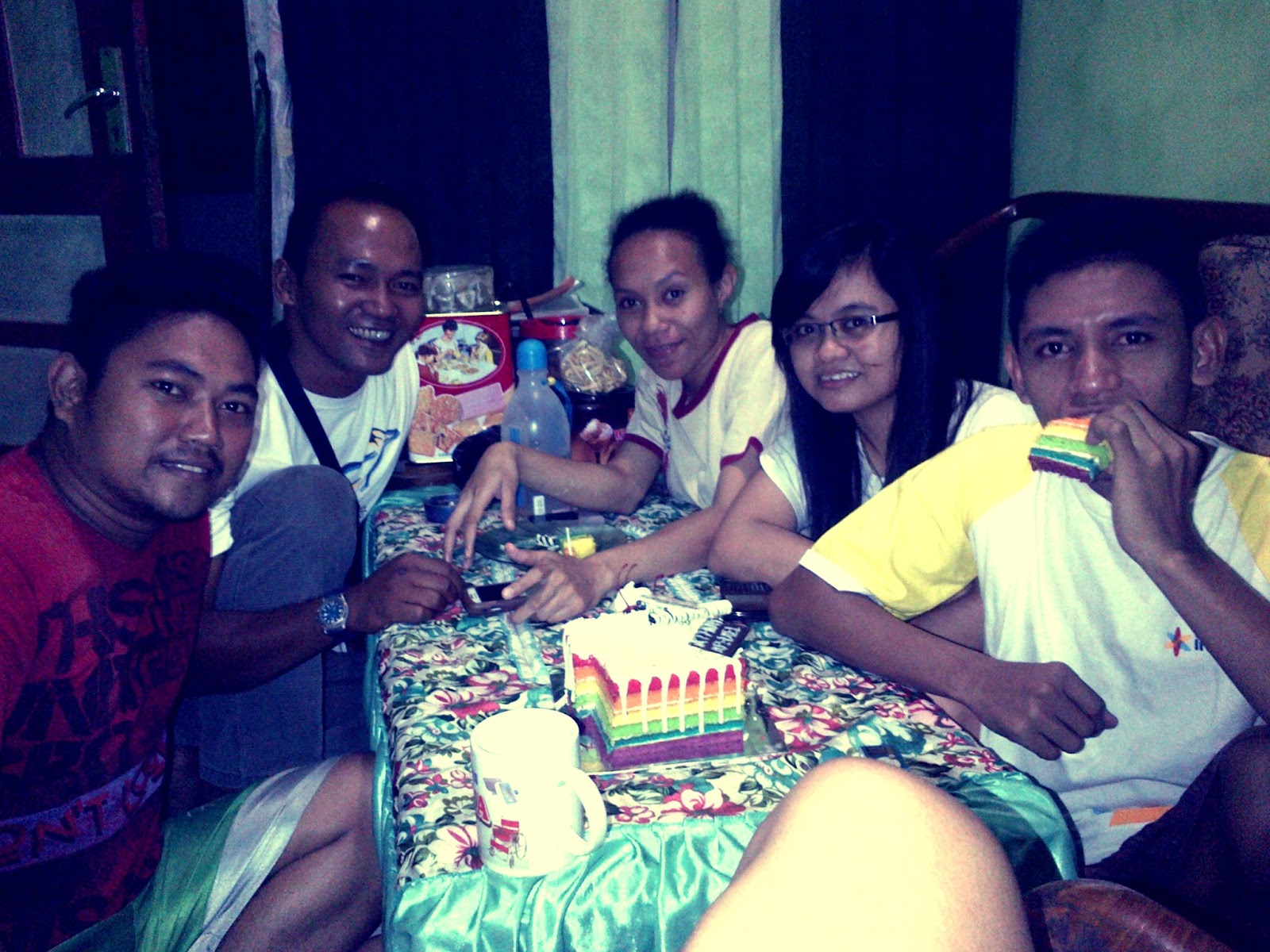
Malam itu, suasana rumah begitu rame dan penuh kebahagiaan, perayaan ulang tahun pacar teman yang begitu sederhana berjalan dengan lancar.
Mas Joe, itulah nama pacar teman saya yang saat itu entah berusia ke berapa, bukan kali ini aku bertemu dengan nya, seorang pribadi yang dewasa dan sekaligus seorang kaka yang baik.
Sembari kue ulang tahun dibagikan kepada kami, budaya saling bertukar cerita seiring mengihasi malam yang boleh dikatakan penuh sejarah ini.
Tanpa persiapan yang berarti, malam itu kami semua bersepakat untuk jalan-jalan ke rumahnya Mas Joe. Saat itu jam dinding menujuk ke angka 8 dan kami semuapun telah selesai menyantap makan malam, tanpa basa-basi kami lalu packing dan persiapan kecil-kecilan sebelum akhirnya cabut dari Purwokerto.
HAPPY BIRTHDAY MAS JOE!!:) :) :)
Setelah kurang lebih jam 10 malam, kami langsung berangkat menuju Wonosobo, oh man! This is the city where I've been very exciting to visit, I feel like I am the lucky person!
Many stories I've heard about this city, some people say it's the cold and fresh city, the others say it's a beutiful and even heaven city and it builds up my curiosity about getting there as soon as possible!
The night was getting tight and lonely road we've through by, wind gently blew and everything turned to an excitement! It took 2 hour from Purwokerto to be in there and suddenly we've arrived safely!
When my friends and I were just arrive, his mother had already slept and his home is very simple and i felt like home to be there.
Tubuh yang capek pun seketika hilang entah kemana setelah mengirup udarah segar yang belum terkontaminasi dengan polusi udarah perkotaan, sungguh suasana yang sangat nyaman sekali.
Saat itu kami berenam: Vian, Esty, Amin, Ayu, Mas Joe dan saya sendiri. Dingin nya malam yang mulai merambat masuk hingga ke hati yang memporakporandakan hati yang saat itu kacau, kelam nya malam yang penuh sejuta misteri dan hangatnya teh tambi asal kota itu yang begitu hangat dan segar, kami semua menikmati itu dengan suka cita dan penuh kedamaian yang tak terukir maupun terukur.
Dan kami melanjutkan cerita yang sempat terputus oleh dalam perjalanan tadi sebelum akhirnya kami larut dalam dingin kelam nya malam sang penghantar raga menuju pulau impian alias tidur.
September 8th, 2013
Good morning WONOSOBO!!!
Pagi itu, seperti dibangunkan oleh suara ledakan bom nuklir, saya pun tersadar dan saat itu dingin nya embun masih menyelimuti kamar, saya yang berbagi kamar dengan Amin, dia masih tampak terkukuh dan terbungkus oleh selimut tebal dan pastinya masih asyik medulang mimpi dan enggan tuk beranjak dari tempat tidur. Sepertinya saat itu saya orang pertama yang bangun duluan, waktu menujuk pukul 05:00 dan seperti si Amin, semua nya belum juga bangun pengaruh dingin yang merasuk dalam hati dan menembus ruang-ruang yang tak terjangkau. Rasanya masih malas juga untuk beranjak keluar karena sebenarnya pagi masih sangat dini, tetapi tuntutan hati dan schedule hari ini yang begitu menarik tuk diarungi, maka saya putuskan tuk melawan keinginan raga tuk kembali tidur dan mengikuti keinginan hati untuk pergi mandi. Saat itu, air di bak ibarat bongkahan-bongkahan es yang di masukan ke dalam nya, nyaris tak mau ku sentuh apalagi buat dipake mandi, namun saya dengan sekuat tenaga dan dengan tekat yang bulat, HARUS MANDI!!! Awalnya saja dingin, namun setelah mandi, pikiran begitu jerih dan tenang, sekujur tubuh begitu segar dan begitu membangkitkan gairah tuk menjalani hari yang panjang ini.
Setelah abis mandi, satu persatu teman saya pun mulai bangun dan Esty dan Vian pun menyiapkan sarapan pagi. Hari itu, sarapan yang sederhana sekali mengingatkan ku pada rumah, nasi kacang merah dan lauk pauk dan sama persis seperti apa yang biasanya mama ku masak. Persis setelah kami semua mandi dan sarapan, kami siap tuk jalani hari yang begitu menyenagkan ini. Sebelum matahari membumbung tinggi mencerahkan hari, kami semua sudah bergegas meningalkan rumah! HERE WE GO!!!!!!!!!!!!
~ Amin and I
~ Vian
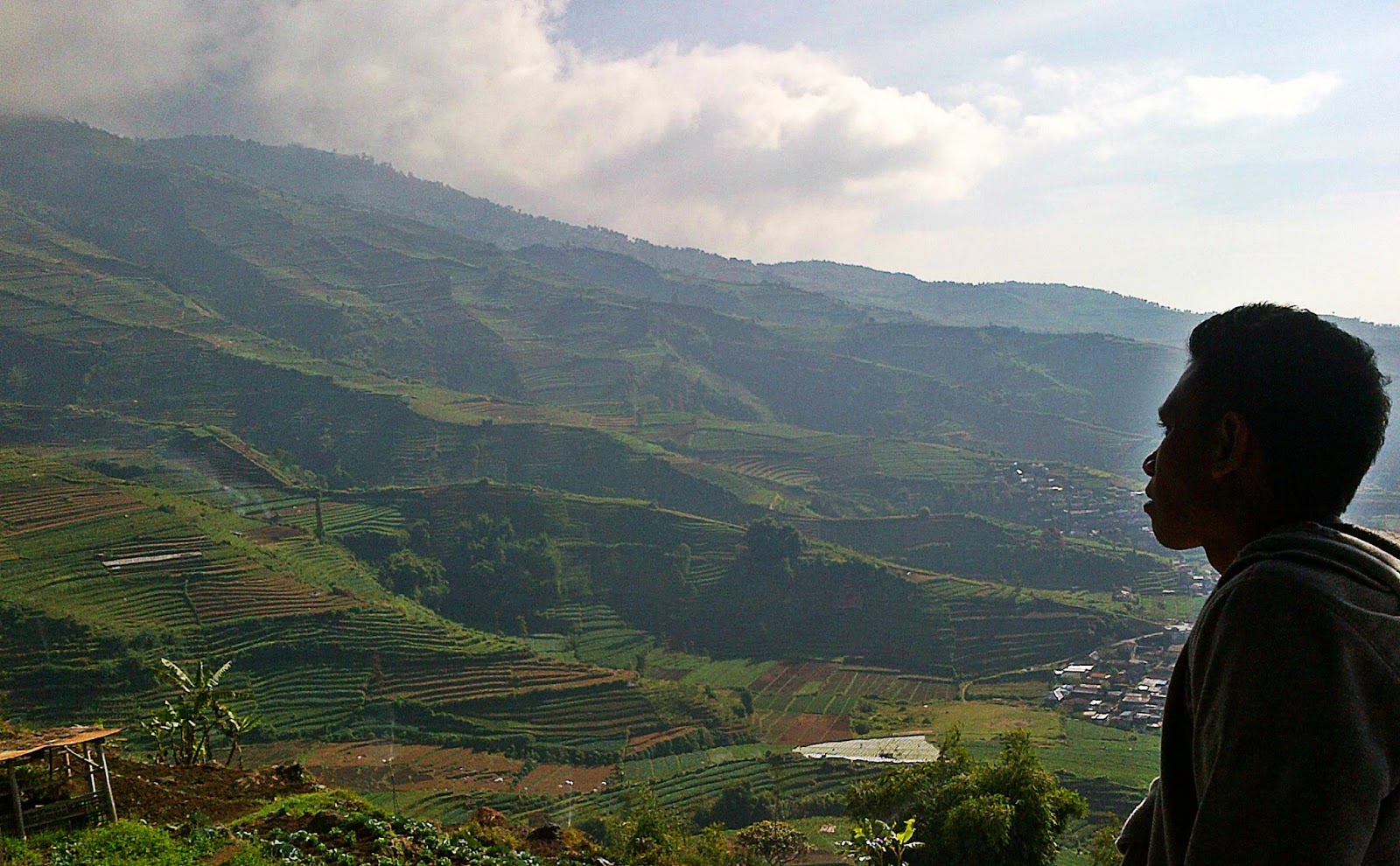
Dalam perjalanan menuju Dieng atau yang lebih di kenal dengan dataran tinggi Dieng, daerah pegunungan yang begitu indah, bersih, rapih dan begitu memanjakan mata, OH GOD! IS THIS THE LOST PARADISE? I JUST CAN SAY NOTHING!!!
Lereng-lereng gunung yang hijau, lekukan-lekukan tubuh lereng gunung yang begitu sexy and exotic! Udara yang murni, di samping lereng yang kami lewati, para petani teh, kentang dll yang baru saja memulai aktifitas mereka dipagi hari, sungguh suatu surga bagi para pencari ketenangan jiwa seperti kami.
Dari kejauhan mata memandang, bunga-bunga mekar, tanaman-tanaman hijau dan pepohonan yang rindang seakan menyambut dan tersenyum pada kami, alangkah indah, ajaib dan perkasanya karya Tuhan bagi bumi ini. Sungguh aku pun tiada henti menyanjung keagungan Tuhan saat itu.
Dari ketingian gardu pandang ini, mata seakan tak mau terpejam, dan takjub dengan keindahan dan pesona gunung Sumbing dan Sindoro. Akupun tak tau harus menjelaskan dengan cara apalagi tentang semua ini.
Bukan manusia kalo gak capek, yeah I am not a bionic man too! Tetapi apapun itu, jalan-jalan adalah hal yang sangat menyenangkan, apalagi melihat obyek-obyek wisata di Wonosobo ini.
Setelah dari gardu pandang, kami langsung melanjutkan perjalanan menuju Dieng dan tentunya ke tempat wisata yang merupakan ciri khas dan unggulan dari Diend itu sendiri.
~ TELAGA WARNA
~ KAWAH SIKIDANG
~ THE OTHER SIDE OF SIKIDANG CAULDRON
Welcome to the Sembungan Village. This is the highest Village in Java Islands!!!
( Amin ~ Vian ~ Ayu & I )
Sebagian orang beranggapan kalau jalan-jalan hanya mengabisakan waktu, bikin capek dan menghabiskan banyak biaya. Apakah memang demikian?
Terkadang segala yang telah terjadi tak akan bisa diulang lagi, jadi pikirkanlah kembali apa yang akan dilakukan sebelum bertindak lebih jauh lagi.
Banyak hal yang sangat menyenangkan yang saya dapatkan dari "TRAVELING" baik perbedaan budaya, kuliner, dan lain sebagainya.
Orang akan lebih menghargai apa yang diceritakan oleh kamu mengenai "PENGALAMAN PRIBADI" dan bukan "BUALAN" atau "OMONG KOSONG" belaka!
Kaum Gypsy selalu mendapat stigma negatif di dunia barat. Kehidupan
mereka yang nomaden, kedekatan dengan ilmu sihir, beberapa tradisi yang
aneh - misalnya ada anggapan bahwa seorang gypsy diperbolehkan mencuri
dari orang kaya - jadi sumber kebencian bagi banyak pemerintahan.
Misalnya saja Prancis terkenal paling getol mengusir keberadaan kaum
gypsy. Pada tahun 2010 silam Pemerintah Prancis menghancurkan 51 kamp
ilegal Gypsy. Mereka semua diusir karena dipandang sebagai "aib" oleh
pejabat Uni Eropa.
Gypsy (atau Gipsi, Gipsy, Gypsi, Gitanos, Zigeuner, Tsigani, Cigány) adalah istilah yang menjuk pada Orang Rom
(jamak roma), artinya "pria" dalam bahasa mereka, adalah istilah yang
digunakan oleh kebanyakan orang Rom untuk menyebut diri mereka. Beberapa
kelompok berbahasa Romani dikenal dengan nama-nama lain, misalnya orang
Sinti.
Orang Rom masih dianggap sebagai kelompok yang nomaden, meskipun
faktanya mereka sekarang telah tinggal dalam rumah permanen. Penyebaran
orang Rom begitu luas tidak hanya di sebelah Selatan dan sebelah Timur
Eropa, melainkan juga di benua Amerika dan di Timur Tengah.
Bahasa, kebudayaan, dan nenek moyang orang Rom bisa ditelusuri ke India
bagian utara kira-kira 1.000 tahun yang silam. Bahasa mereka, selain
beberapa kata yang ditambahkan pada masa-masa selanjutnya, tidak
diragukan berasal dari India. Alasan mereka meninggalkan India kurang
jelas. Beberapa pakar percaya bahwa nenek moyang mereka bisa jadi adalah
perajin dan penghibur yang bergabung dengan pasukan prajurit yang
meninggalkan tanah airnya setelah konflik-konflik militer. Apa pun
alasannya, orang Rom tiba di Eropa sebelum tahun 1300 M melalui Persia
dan Turki.
Kajian para peneliti terhadap asal muasal gypsy yang mengarah dari nenek
moyang mereka di India terus dilakukan guna mencari bukti otentik.
Temuan terbaru yang dilakukan oleh Pusat Biologi Seluler dan Molekuler
(CCMB) menghasilkan data ilmiah bahwa memang benar kaum gypsy dari
India.
"Kami telah membandingkan data phylogeographical seluruh dunia untuk
haplotype India H1a1a dengan Roma dan menyimpulkan bahwa suku asli ini
berasal dari populasi di bagian Barat Laut India. secara tradisional
mereka disebut sebagai Doma dan juga dikenal sebagai kaum Dalit yang
menjadi leluhur kemungkinan besar modern Eropa Roma," papar Kumarasamy
Thangaraj dari CCMB.
Orang-orang Rom adalah kelompok etnis yang mayoritas terkonsentrasi di
Eropa, terutama Eropa Tengah dan Timur. Diyakini, mereka telah
bermigrasi dari India Barat Laut sekitar 1.000 tahun yang lalu.
Mengapa mereka memilih hidup dalam karavan?
Karena terkait dengan kultural sebagai kaum nomaden menjadikan orang
Gypsy memilih hidup di karavan. Mereka tak pernah menetap lama di satu
tempat. Kebiasaan ini agar memudahkan saat berpindah. Biasanya satu
karavan paling tidak bisa menampung 4 hingga 5 orang. Walau belakangan,
tak semua orang Gypsy pasti tinggal di karavan. Sudah banyak juga yang
tinggal menetap.
Sihir Gypsy
Banyak legenda dan mitos seputar dunia sihir pada kaum Gypsy. Dipercaya
bahwa perkembangan penyihir wanita di daratan Eropa (witchcraft, witch)
terkait dengan kepercayaan kaum Gypsi
Beberapa orang Gypsy terlahir sebagai Shuvani - penyihir tingkat
tinggi.Shuvani lebih kuat daripada Gypsy lainnya. Contoh-contoh kekuatan
seorang Shuvani misalnya:
Spell Casting: Kemampuan untuk merapalkan mantra dan melakukan ritual.
Potion Making: Kemampuan untuk meracik ramuan sihir.
Scrying: Kemampuan untuk mencari seseorang atau benda dengan menggunakan bola kristal
Divination (ramalan): Kemampuan untuk memprediksi masa
depan. Gypsy memiliki hubungan yang sangat kuat untuk meramal melalui
berbagai cara. Kartu tarot dan ramalan tangan dipercaya berkembang pesat
karena mereka.
Mediumship: Kemampuan untuk melihat roh orang yang
meninggal. Orang Gypsy menyebut penampakan tersebut sebagai "Mulo", yang
dipandang sebagai pertanda atau peringatan.
New York-based photographer Richard Silver
is a passionate traveler, and his primary goal as an artist is to share
his life experiences by creating beautiful photographs during his
travels. Rather than shoot traditional photos, he uses techniques such
as tilt shift, HDR, panorama, and time-slice in order to capture the
world in eye-catching ways. Last year we shared his time-slice photos of NYC, which showed day turning into night in single photos.
Another major project he has been working on is called “Tilt Shift.” He has been photographing some of the world’s most famous locations and turning them into miniature scenes.
The project contains photos snapped in locations ranging from the famous
structures of Machu Picchu (as seen above) to runners streaming down a
road during the New York Marathon.
Silver says, “People always ask me, How do I make people look so
small or why do I make people look so small? Simple, we are!” Thus, his
goal with the project is to “give the viewer a new way of seeing
themselves and their place in the world.”
The photographer tells us he was inspired by the tilt-shift work of Italian photographer Olivo Barbieri.
However, instead of using an actual tilt-shift lens, Silver shot
“normal” photographs and then applied an artificial shallow depth of
field to the images using Photoshop during post-processing.
“I appreciate the freedom that digital gives me especially with this ongoing project,” he says.
So far, Silver has already visited all 7 New Wonders of the World (one of the lists, at least), and has applied this tilt-shift style to all of them.
The US Open in New York City
Verrazano-Narrows Bridge in New York City
Ha Long Bay, Vietnam
Acropolis
Ahu Tangariki
Palm Islands in Dubai
The White House in Washington, DC
The World Trade Center Memorial
The Western Wall in the Old City of Jerusalem
Colesium
The Great Wall of China
Teotihuacan, Mexico
Brooklyn Bridge
Roman ruins
The New York Marathon in 2011
Balloon Fiesta in Albuquerque, New Mexico
Zocalo, Mexico
Hagia Sophia in Istanbul, Turkey
Snow walkers in Iceland
Silver’s photographs are now being exhibited in galleries located in
many of the countries he has visited (over 50 of them around the world).
The word ‘jewelry’ traces its origin to the Latin word ‘jocale’,
which literally meant ’plaything’. The word ‘jewel’ was has been derived
from the old French word ‘jouel’, anglicized in the 13th century.
Jewelry has been used for ages, though not necessarily for the purpose
of ornamentation. In the most basic form, jewels have been used, since
the times when early humans began to use tools and wear clothing. As
humans became proficient in the use of tools and metals, the crude
jewelry progressed to assume beautiful shapes and designs. The article
dwells on the history of jewelry at length. Read on to know some
interesting information and amazing facts about how it came into
existence.
Interesting & Amazing Information On Origin & Background Of Jewellery
It is interesting to note that that jewelry which is today
available in such exquisite designs, glossy stones and material was
first made of readily available natural materials, such as animal teeth,
bone, different types of shells, carved stones and wood. Initially,
jewelry was more of a functional item, used to fasten articles of
clothing together, and it was not associated with decorative purposes.
However, with the passage of time, it was adapted for being purely used
as an object of aesthetic ornamentation. It also came to be used as a
spiritual and religious symbol.
The first gemstones are considered to be gathered in as much the
same way as food. It is highly likely that the gems came to an
accidental notice, while the primitive humans were searching for food,
picking through alluvial gravels in a dry river bed that contained gems.
Prima facie, these dazzling, rather useless pieces of stones were
harder than any naturally occurring substance and their transparency
could be used for capturing the warmth of fire, brightness of sun and
blue depth of sea and sky. However, even the primitives soon learnt the
right use of these precious stones and as mankind progressed, jewelry
very well became a symbol of wealth and status.
It was the ancestors of Homo Sapeins, which actually began the
tradition of making jewelry for the purpose of ornamentation. Early
humans traveled from Central Africa to the Middle East, the Indus
Valley, and to the continent of Europe, collecting objects that
interested them and fashioning them into pieces of jewelry, notably to
narrate the story of their journey. Mas d’Azil is a paleolithic cave
site in the mountains of France, where a French archaeologist found
necklaces and bracelets made of bone, teeth, mother-of-pearl, shells and
stone, strung together with a single piece of twine. This jewelry
roughly belonged to the period between 17,800 and 6,500 BC.
The earliest used metal for making jewelry was ‘’free gold’’, which
was found in Spanish caves and was native to the region. The initials
signs of crude metallurgy were witnessed over 10,000 years ago, when
native copper, meteoric iron, silver and tin were first used by humans
to create tools and possibly, jewelry. While the history of jewelry
suffers from the lack of credible documentation, perhaps due to its
archaic roots, there is no denying the fact that the contemporary pieces
of jewelry worn by women today, has evolved through a series of phases,
to enjoy the popularity it holds today.
Source was taken from: The Den Toronto (http://thedentoronto.tumblr.com/)
In jazz and related musical styles, the term swing is used to describe the sense of propulsive rhythmic "feel" or "groove"
created by the musical interaction between the performers, especially
when the music creates a "visceral response" such as feet-tapping or
head-nodding (see pulse). The term "swing" is also used to refer to several other related jazz concepts including the swung note (a "lilting" rhythm of unequal notes) and the genre of swing, a jazz style which originated in the 1930s.
As swing jazz was dance music and coevolved together with swing dances such as Lindy Hop, the term swing
can be understood as music that makes you want to dance. Even though
there is overlap between these concepts, music from any era of jazz or
even from non-jazz music can be said to have "swing" (in the sense of
having a strong rhythmic groove or feel).
While some jazz musicians have called the concept of "swing" a
subjective and elusive notion, they acknowledge that the concept is
well-understood by experienced jazz musicians at a practical, intuitive
level. Jazz players refer to "swing" as the sense that a jam session or
live performance is really "cooking" or "in the pocket."
If a jazz musician states that an ensemble performance is "really
swinging," this suggests that the performers are playing with a special
degree of rhythmic coherence and "feel." Although referring to a "sense
of swing" is often done in the context of ensemble performances (e.g. a
jazz combo or band), even an unaccompanied soloist can be said to be
performing with "swing."
The History of Swing Music
What Makes a Song Swing?
We know it when we listen to it. Our feet tap along, our hips may move
from side to side, and our fingers snap in sync with an unmistakable
beat. It's easy to know what feels like swing music, but what is it that makes a song swing?
A typical swing song features a strong rhythm section supported by a
more loose brass section, and later a string and/or vocal section.
Improvisation is common in live swing performances, but depends on the
song, band or the band-leader. As the song progresses, multiple soloists
can pick up the baton and pass it on, but commonly there are two or
three band members improvising. Swing bands tend to be bigger than other
jazz bands, requiring a more organized and detailed composition,
notation as well as more energetic arrangements. By having such a
hierarchal structure, swing bands prevent chaos that may come from the
improvisation of twelve to sixteen musicians.
History
Swing developed in the 1920s as a mixture of West African and Western
European rhythms, and progressively evolved around America- from lively
jazz experimentations in New Orleans to Kansas City and New York. While
swing is a distinctly American style of music, the precursors to swing
developed in places like Cuba, Haiti, Puerto Rico, and Brazil by the
slave populations, though they often receive no credit in the genre
because of an inability to record music and historical racism.
Although swing finds its roots in the 1920s, swing is known as the
music of the 1930s and 1940s. During the 1920s, swing was mostly played
and enjoyed by African Americans. As the audience grew, musicians and
band-leaders were under pressure to develop "softer" music for more
conservative Anglo-American listeners. White listeners found African
American swing to be vulgar and low class, though this was due to racism
more so than legitimately offensive content. However, by 1939, the
resistance against swing music in America had vanished, and America was a
proudly swinging nation.
The Swing Kids (Swingjugend)
Similar conflicts arose when swing became more popular in other
countries. In Germany, swing music often confronted and even mocked Nazi
ideology, and was consequently forbidden or censored. Swing music in
Germany was frequently performed by African immigrants as well as Jewish
musicians. The Nazi party labeled swing as "Negermusik" (nigger music)
and “entartete musik" (degenerate music). Thus, the Swing Kids (German: Swingjugend)
arrived. Mostly concentrated in large cities like Berlin, the Swing
Kids used music as a political tool against the Nazi party. The name of
the movement itself poked fun at Nazis. "Swing Kids" or "Swing Youth"
was a parody on the numerous “youth groups” promoted by the Nazi
government. They also used their greeting “Swing Heil," as a parody of
“Sieg Heil,” the Nazi salute.
Perhaps the most surprising information about the Swing Kids is the
fact that they were literally children. The Swing Kids were composed of
14 to 18-year olds that usually still attended school. They were mostly
members of the upper-class because they needed to have access to records
and music that was not played on German radio. They were against
Nazism, especially the Hitler Youth and they found themselves longing
for the American and British way of life, and thus defined themselves
through swing music. They referred to themselves as “Swings”; members
were also called “Swing-Boy”, “Swing-Girl” and “Old-Hot-Boy.” Swing kids
used their appearance as a primary form of protest, with boys growing
out long hair, girls wearing flashy make up and both genders wearing
oddly patterned, flamboyant clothing.
While swing music was forbidden in Nazi Germany, the Swing Kids
experienced no threatening government opposition until August 18, 1941.
An unexpected and violent police raid resulted in the arrest of 300
Swing Kids. Punishment ranged from chopping off the kids' hair and
sending them to special schools, to imprisoning more prominent Swing Kid
figures in youth concentration camp. This raid created a battle between
the Swing Kids and the Nazi government, which resulted in years of
brutal raids of underground clubs, arrests and riots. Finally, in
January 1943, the Swing Kid movement took a crippling blow, when leader
Günter Discher was arrested and imprisoned in the concentration camp of
Moringen.
Director Thomas Carter released a film in 1993 titled Swing Kids,
and the film provides a relatively accurate historical look at the
Swing Kids movement by Hollywood's standards. The film stars Robert Sean
Leonard (Television show House, Film, Dead Poets Society) and Christian Bale (Film, The Dark Knight).
The Decline of Swing
Swing music become less popular during World War II because of two
reasons. Firstly, and most importantly, it was very difficult to start a
band since many musicians went to war and overseas. Secondly, big band
touring became more expensive due to war economics. This made smaller
ensembles, 3 to 5 musicians, more common, which changed the sound of
swing and gave rise to rhythm 'n' blues, jump blues and bebop. The last
true to the era swing records were released in the year 1947 and by 1949
swing metamorphosed into several different music genres, such as r'n'b,
jump blues, bebop, rock 'n' roll, country, western, funk, etc.
Famous Swing Musicians
The
most famous swing musician, as many consider him to be, is Benny
Goodman, nicknamed “King of Swing” because of the role he played in
evolving musicians from a jazz style into swing. Another famous musician
is Artie Shaw, the only one to ever challenge Benny Goodman's crown.
Other famous swing musicians are Glen Miller, Count Basie, Duke
Ellington (famous for his piano playing) and Cab Calloway. Some of the
most famous female swing and jazz singers are Ella Fitzgerald and Billie
Holiday as well as Diane Shuur, Ivie Anderson, The Boswell Sisters and
others.
Swing Dance
The traditional swing dance we think of when watching classic films
developed well after swing music itself developed, several years later.
Strong rhythms and loud, insistent tunes led to a new creation in the
black community; an energetic, vibrant and improvised dance better known
as swing dance. These swing dances originated in, and became popular in
New York City, Kansas City and Chicago.
Charleston
While the Charleston did not originate as a swing dance (but instead as
a flapper dance during the early 1920s), it was very popular in the
swing music scene of the 1930s, and easily recognized today. The
Swinging-Charleston, a modified partner form of the dance, was
especially popular during the 1930s. The dance involved eight counts,
and centered around the alteration of arm and leg movements to produce
an almost "hop" like step in the middle.
Lindy Hop
The Lindy Hop started in Harlem, late in the 1920s and the early 1930s.
It's characterized by improvisation and dancing both with and without a
partner. Most people recognize the classic "swing-out" movement of the
Lindy Hop Dance, where dancers hold hands and extend arms and come back
together in an embrace. Famous poet Langston Hughes often frequented
Harlem night clubs, where he observed and subsequently wrote about the
Lindy Hop.
Saint Louis Shag
The St. Louis shag is a modified Charleston style swing dance. Unlike
most swing dances, the St. Louis shag is oddly structured, with a
pattern of movements: rock step, kick forward, step down, kick forward
(other leg), stag, step, and stomp (repeat). The St. Louis shag is
typically done to very fast swing music, with a partner kept in close
contact.
East Coast Swing
East Coast Swing (know by many other names including Single-Time Swing,
Triple-Step Swing, 6-Count Swing,) was a popular form of swing dancing
because it used very simple footwork and could be adapted to any style
of swing or jazz music. A dancer, with their partner must first rock
back on one foot, forward on the other, and then step with each one,
producing a "rock, step, step step" four count pattern. The single rock
movement made this dance simpler than most, and was enjoyed by even the
clumsiest of dancers.
Swing Revival
Even though ensembles such as the Count Basie Orchestra and the Stan
Kenton Orchestra survived for decades, a new wave of swing music
appeared (though lasted shortly) in the 1990s and the early 2000s. Swing
music as well as swing dancing (which has always been and still is
popular, unlike swing music) was brought back to life by various films (Swingers,Swing Kids & Blast from the Past)
as well as commercials (Gap's advertising campaign that featured Louis
Prima's song Jump, Jive and Wail). Bands of the neo-swing period base
their music on the rock instrumentation of bass, guitar and drums, but
with addition of a few horn instruments, and tend to be more rehearsed
than the traditional "hot" improvised swing of the past.
The Swing Era
Jazz began to "swing" as musicians began to adopt
swing eighths, th estring bass, high hat cymbals, and a looser, more rythmic
feeling . This change occurred gradually starting in the twenties with musicians
such as Louis
Armstrong, and continued on into the 40's. A lot of the music that came
out of this period was played by bands of ten musicians or more. Because of
this the swing era is also often known as the big band era. Some big bands
didn't include a lot of improvisation. Other big bands such as that of Count
Basie placed great emphasis on improvisation.
Jazz music had been played as a form as entertainment since
its inception. During the swing era jazz music developed into tremendous music
to dance to. Jazz groups seldom performed just for listening. Swing dansing
was an extremely popular past time. During this era, jazz achieved wide popular
appeal. One of Count Basie's recordings, One O'Clock Jump, sold over a million
copies.
The
beginnings of the swing era can be traced to developments of larger bands
by Fletcher Henderson in New York, and Bennie Moten in Kansas City. Fletcher
Henderson along with his brother Horace and with Don Redman created the pattern
for swing arrangments. Henderson helped establish the independent use of trumpet,
trombone, saxophone, and rhythm sections with the use of soloists. A swing
score generally has specific notes for each instrument to play in every measure.
Then the music arranger decides which measures will be used for solo improvisation.
The score is then taken to a music copyist who extracts the individual parts
for the various instruments.
When the depression hit the U.S. in 1929 the entire music business
sudddenly failed. Some players, such as Benny
Goodman were able to find employment in staff radio jobs. Others, such
as Louis
Armstrong and Duke
Ellington left the United States for Europe. Some jazz authorities believe
that the swing era was launched in 1934 when Benny
Goodman left the radio business to form his own band. However, by 1934
Duke Ellington
as well as Fletcher Henderson had already formed large swing bands that played
in the Kansas City area.
Swing bands started to play a large part in people's lives in
the late 30's as people tried to shake off the depression by dansing. Large
ballrooms were extremely common and therefore large bands were also needed.
Bands
of the swing era produced a much fuller sound than the sound produced by earlier
dixieland jazz bands. The resulted from the use of two to three times as many
players. Because there were more players, swing music was organized in a homophonic
construction. This resulted in the music sounding less complex and more organized
in its effect. Block chords used by swing bands are a prime example of homophonic
construction.
The swing era is dominated by the big bands that played to huge
audiences during this period. Two of the largest big bands were Count
Basie's and Duke
Ellington's. Benny
Goodman also led several influential swing bands. Within the big bands
there were also many individuals who distinguished themselves. Lester
Young and Coleman Hawkins
were two extremely talented saxophone players who became well renowned
for their improvisational prowess. Ella
Fitzgerald wowed crowds with her silky smooth voice and upbeat scat singing.
(This summary by Sean Glass using information
from Jazz by Tanner, Megill and Gerow and Jazz Styles by Mark
C. Gridley.)
Notable Swing Musicians
Without
these legendary greats, the music scene today certainly would not be
the same. They contributed their creativity, talent and lent that zing
to the era of Swing. What I note here as I write this is that these
musicians had a warm connection with each other, yet wer able to develop
their own styles.
Thought
of as one of the most influential musicians in the swing era, Duke
Ellington rose to fame as he performed weekly in the New York Cotton
Club. His band stayed with him through decades of recording, producing
such evergreens as “Take the A train”, “It don’t mean a thing if you
ain’t got that swing”, and “In a sentimental mood.”
A creative mind, he experimented with harmonic and formal devices that are now considered jazz standards.
Hawkins
had a unique, raspy tone and an unquestionable command of musical
improvisation, a style he developed as a member of Fletcher Henderson’s
Big Band. He became famous later touring as a soloist. His 1939
composition Body and Soul has become a landmark improvisation in Jazz
History. His influence has lasted through Bebop and later styles as
well.
A
great pianist, Basie began to garner attention when he moved to Kansas,
a jazz hotbed, and began playing with Bennie Moten’s Big Band. He broke
off from the band to form his own group in 1935 and they became one of
the most popular bands in the country. The sparse precision of his piano
style was catchy and rousing. He made famous recordings with the likes
of Joe Williams, Ella Fitzgerald, Frank Sinatra and Tony Bennet. He
developed a style known as the Basie Boogie.
A man ahead of his time, Art was a prodigious talent. Not really
associated with any swing bands, he was a premier keyboardist during the
time. What was fascinating was that his spectacular harmonic knowledge
and technique was developed completely by ear. He used it to construct
elegant, beautiful harmonic lines played at breakneck tempos. His music
set the standard for musicians of bebop in the 1940’s and 50’s. Listen
to his version of Tea for Two.
Along
with Coleman Hawkins and Lester Young, Webster was one of the three
titans of the saxophone during the swing era. He was versatile, and his
style could growl through uptempo or sensitive ballads. He recorded a
version of Cotton Tail that is seen as one of the gems from the period.
He spent the last years of his career as a celebrity in Denmark.
A
son of Jewish Immigrants, Benny Goodman moved to New York from Chicago
in the late 1920s. He began leading a band for a weekly radio show in
the 1930s. He is credited with bridging racial divides, making the music
of black musicians popular among Caucasian audiences, therefore
considered as instrumental in the bolstering of swing music. He was also
thought of as one of the best jazz clarinetists of all time.
Another
of the three tenor saxophone greats, Lester Young began his career in
music touring with his family’s band. Versatile, he played on a variety
of instruments. His more relaxed style of music was not often accepted
by those more used to Hawkins’ harsher style. He became influential on
bebop eventually, and was given the nickname Prez by Billy Holliday.
So it is time for a little female power. The Andrews Sisters were a
highly successful close harmony group during this era comprising Maxene
Angelyn Andrews, LaVerne Sophia Andrews and their sister, Patricia
Marie, they sold well over 75 million records. They made hits like
Boogie Woogie Bugle Boy was an early example of rhythm and blues. Their
hits have been covered by Bette Midler and Christina Aguilera. A
personal acapella favorite of mine is Don’t Sit Under the Apple Tree.
Boogie Woogie Bugle Boy
The Andrews Sisters - Don't Sit Under The Apple Tree
Armstrong came to prominence as a Cornet and Trumpet player in the
roaring ‘20s. He was given the nickname Satchmo or Pops. A foundational
influence on Jazz, Armstrong had a distinctive, gravelly voice which
could be heard in songs like What A Wonderful World and his popular,
best selling rendition of Aint Misbehavin’. Armstrong developed his
cornet playing in Fletcher Henderson’s orchestra. His artistry allowed
him to be an unquestionable influence on music of the time. Together
with jazz vocal greats like Ella Fitzgerald, he developed the technique
of ‘scat singing”, a popular vocal technique among jazz singers which
involves musically vocalizing random sounds.
A
must-mention name in the Big Band Era, Miller and his Orchestra brought
unforgettable, catchy and danceable compositions to audiences. One of
the best selling recording artistes from 1939 to 1943, he led one of the
best know big bands of the era. Evergreen (yes, I still jive to this)
hits include In the Mood, Chattanooga Choo Choo and Tuxedo Junction. He
and his band unfortunately disappeared in the bad weather over the
English Channel in 1944 when he was asked to perform for the US troops.
His official Military Status remains as Missing In Action. Many theories
and books, like I Kept My Word: The Personal Promise Between a World War 2 Army Private About What Really Happened To Glen Miller by Clarence B Wolfe.
Fletcher Henderson
Fletcher Henderson Wrapping It Up
Famous
for being a band leader who groomed greats like Louis Armstrong and
Coleman Hawkins, I must definitely not leave him out of this list. He
was instrumental to the swing era and the influence of his prolific
black orchestra was vast. He was a director for the Black Swan label
from 1921 to 1923. He provided solo accompaniment for many blues and
jazz singers. He formed his own band which began playing at the Club
Alabam and became widely known as the best African American band in New
York. Originally a dance band, the addition of Louis Armstrong showed
him that there could be a great potential for jazz. The band then grew
into jazz greatness.
Truly
a legendary singer of the era, Sinatra, a bobby soxers idol, released
his first record The Voice of Frank Sinatra in 1946. Signed to Columbia
Records, he made such hits as My Way, Strangers in the Night and Come
Fly With me.
1940 marked the birth of Sinatramania, which lasted into the 1950’s.
He won the award for Best Supporting Actor in From Here to Eternity. He
released several critically acclaimed albums after signing with Captiol
records in 1953.
Sinatra’s generation was the first of the era to grow up with the
microphone. He and others after him began using a personalized, softer
and more nuanced style. What was truly outstanding and drew audiences
was his incomparable vocal range.
On a personal note, what is special about Sinatra was how my
grandfather emulated him and constantly sang his songs. His perennial
favorite was My Way, which my grandfather sang and recorded himself
before passing away from cancer. We played the song as the hearse was
being taken from the church at his funeral.




 Thus, the Swing Kids (German: Swingjugend)
arrived. Mostly concentrated in large cities like Berlin, the Swing
Kids used music as a political tool against the Nazi party. The name of
the movement itself poked fun at Nazis. "Swing Kids" or "Swing Youth"
was a parody on the numerous “youth groups” promoted by the Nazi
government. They also used their greeting “Swing Heil," as a parody of
“Sieg Heil,” the Nazi salute.

 The
beginnings of the swing era can be traced to developments of larger bands
by Fletcher Henderson in New York, and Bennie Moten in Kansas City. Fletcher
Henderson along with his brother Horace and with Don Redman created the pattern
for swing arrangments. Henderson helped establish the independent use of trumpet,
trombone, saxophone, and rhythm sections with the use of soloists. A swing
score generally has specific notes for each instrument to play in every measure.
Then the music arranger decides which measures will be used for solo improvisation.
The score is then taken to a music copyist who extracts the individual parts
for the various instruments.
 Bands
of the swing era produced a much fuller sound than the sound produced by earlier
dixieland jazz bands. The resulted from the use of two to three times as many
players. Because there were more players, swing music was organized in a homophonic
construction. This resulted in the music sounding less complex and more organized
in its effect. Block chords used by swing bands are a prime example of homophonic
construction.


